How to search the internet efficiently?
5 minutes read
The internet is a vast place, and although it theoretically contains infinite (as in more than you could ever learn) amounts of knowledge, it can be hard to browse.
Over the years, I developed a few tricks to efficiently search for information on a given topic. None of those tricks are revolutionary, but I decided to make a list mostly for myself to not forget, and maybe they can be useful to you too!
Search Engines
I mostly use Google and Duckduckgo, and I'm currently testing Kagi. Most of these search engines support dorks to improve your search.
I feel like search engines have gotten increasingly bad over the years, more and more AI slop is pushed at the top of my searches, or the search results have nothing to do with what I actually asked for. However, they are still the main gateway for the internet and a necessary evil that you should know how to use efficiently.
A list of dorks I find useful:
"mysearch"(double quotes): I'm sure everybody is familiar with this dork, but it's probably the one I use the most. This allows us to force an exact match of the wordmysearchin the results.site:reddit.com: only list results fromreddit.com. I frequently use this to only filter results from Github or Reddit. Although Reddit lost some of its superb over the years (especially after the API drama), I still think it's one of the best place to get quick information on a particular topic, with some subreddits containing domain experts.inurl:config.json: only search for websites withconfig.jsonin their URL.intitle:index: search for pages withindexin their HTML<title>tag.intext:myword: search for pages withmywordin page content.filetype:pdf: only search PDFs.ext:json: similar tofiletype, only search JSON files.-"<term>": excludes the term from the search.- There are a ton of other dorks, c.f. this cheatsheet
Github
As a developer, searching through other people's code can teach invaluable lessons.
This is where you can learn extremely neat programming tricks from niche projects.
This is where you can find the solution for the bug you've been fighting for hours, right here in a repository with 0 stars and that is 2 years old. Mandatory reference to the XKCD classic:
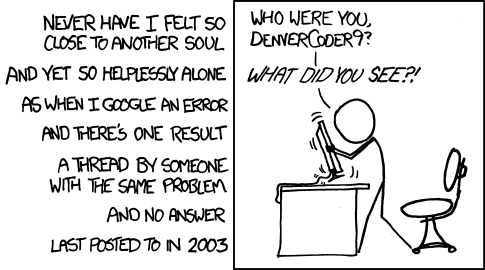
Github has a certain number of dorks that can help make your search more efficient:
language:rust: only files Github identified as Rust files.extension:json: only.jsonfiles.path:config: only files withconfigin their path.filename:main.rs: only files namedmain.rs.stars:>10: only projecs with more than 10 stars.involves:silentvoid13: search issues/PRs involving a particular user.topic:android: search repositories with a category tag.in:readme,in:description: search only in the README or description of the repository.NOT <term>: excludes the term from the search.
Examples:
- I recently wanted to find some cool open-source keyboard Android applications:
topic:keyboard stars:>200 android, then sort by recently updated to only get actively maintained projects.
LLMs
I think Large Language Models are a fantastic alternative as a better search engine for simple things.
This is in essence the whole purpose of an LLM: a statistical mathematical representation of an absurd amount of data that can be easily queried however we want (over-simplification, I know)
If I have a doubt on the syntax of something, or if I want to grasp the surface level knowledge on a given topic, an LLM is almost always faster at giving a response than searching on Google.
I mostly use ChatGPT and Claude, with some touch of Mistral or DeepSeek when I feel like it.
Of course, they're not the answer to everything and it's important to know how to think and do research without them, but they are a really useful tool in my arsenal.
Some people have very strong feelings about Artificial Intelligence, I personally think that LLMs are tools and you should simply evaluate and maximize how they are useful to you in your workflow.
I recently was listening to DHH on the Lex Fridman podcast and he had a balanced opinion on Artificial Intelligence I very much agree with. Essentially he felt that when using AI to learn and ask as many dumb questions as he wanted whenever he had a doubt, he was getting .5% smarter every day. However, if he let AI do all the work, vibe coding everything and not typing things out himself, he was getting .5% dumber every day.
If you want to learn how to be an experienced programmer, you have to program. You don't get fit by watching fitness videos. That's the spirit: use AI to get smarter, to sharpen your skills, to improve yourself. If you use AI to do everything for you, you're effectively surrendering your ability to learn and become better